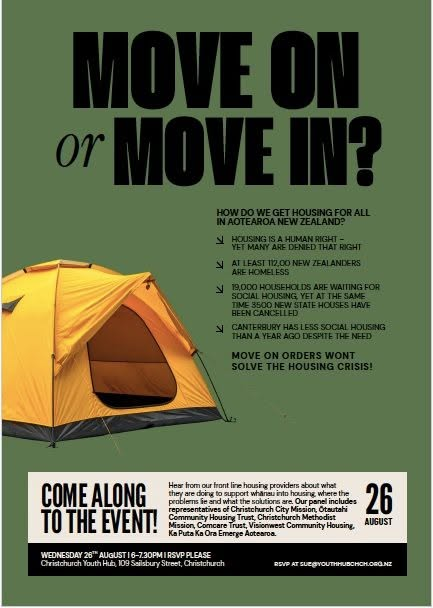
This month we are inviting Tuesday Club readers to attend a public meeting this week addressing the issue of homelessness in our city and our country. Thanks to Rebecca McFie and friends for organising it…
Here are the details of the event:
Move on or Move in? A hui on Ōtautahi’s housing crisis
6-7.30 Wednesday 26 August
at Youth Hub 109 Salisbury St
Confused about housing? People sleeping on the street, in parks and under bridges while rows of new terraced houses in Ōtautahi’s city centre sit empty? Homeless people to face move on orders, but to where?
Housing is a human right, yet many in this city are denied that right. What’s going on?
Hear from our front line housing providers about what they are doing to support whānau into housing, where the problems lie and what the solutions are. Speakers include: Jill Hawkey, Cate Kearney, Jonny Revely, Lindsey Webber. Ask questions and find out more.
Recently there has been 3 people who were homeless die on the streets of this country. In a country with our resources this is shameful. One of those was found freezing on the beach at Brighton and subsequently died in hospital.
There have been many media articles focusing on homelessness including this film by Gerard Smyth at Frank Films
Rebecca Macfie wrote a superb analysis for last week’s Listener magazine
What is the latest response from the Government on homeless housing solution for our city?
In this announcement at the end of last week
How did the matter of homelessness evolve?
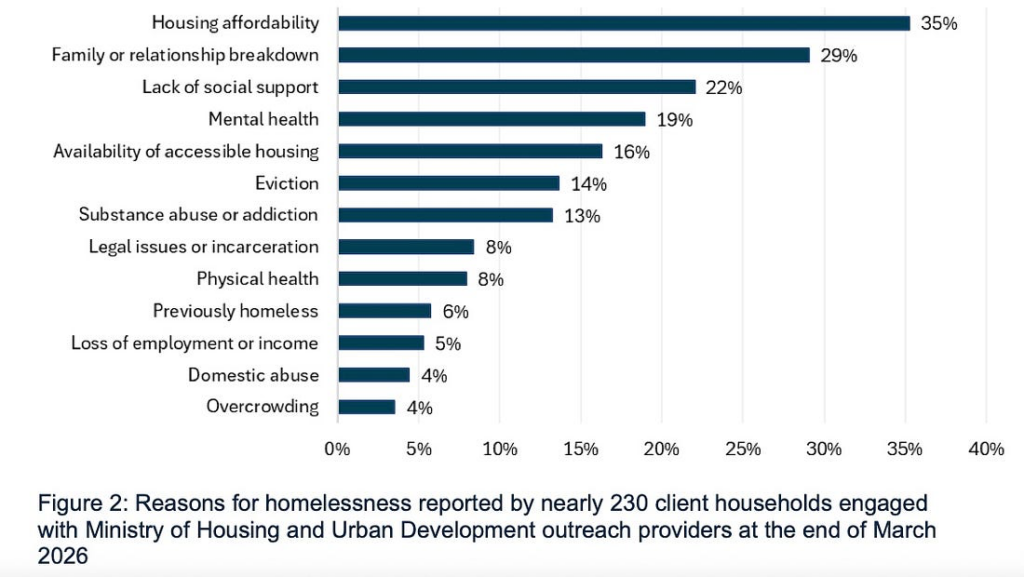
The issue of homelessness can be rested at the feet of several governments. This is not the sort of issue which just happens. It reflects not enough investment in community and state housing solutions, alongside people losing their jobs, and for many mental health and often experiencing breakdown in their personal lives. Here’s some data from a very small sample taken by MHUD in March this year.
Not everybody video recorded their sad decline into homelessness, but Caitlin McDonald did. Here’s a link to her story.
Bernard Hickey wrote in his daily newsletter “The Kaka”
Homelessness in New Zealand is not a natural disaster, an unfortunate accident, or a mystery. It is the predictable product of decisions made by successive governments — decisions about who gets housed, who gets subsidised, and who gets moved along. And in 2026, the political class has converged on a tacit consensus: the problem is to be managed, hidden, counted down and spun — not fixed.
The right’s answer is policing. The left’s answer is condemnation of the policing, unaccompanied by any plan remotely matching the scale of the need. The homeless person has become a problem to be managed for the comfort of everyone except the homeless person.
…and
But this is Victorian vagrancy law revived: poverty itself redefined as a public nuisance. And look at who opposed it. Officials warned it would make homelessness worse. Oranga Tamariki and the Ministry of Justice didn’t support it. The Attorney-General found the bill appears inconsistent with the Bill of Rights Act. Even the police were reluctant to lead a response to homelessness. Justice Minister Paul Goldsmith batted all of this away.
This government’s recent response to homelessness has been dreadful. They have:
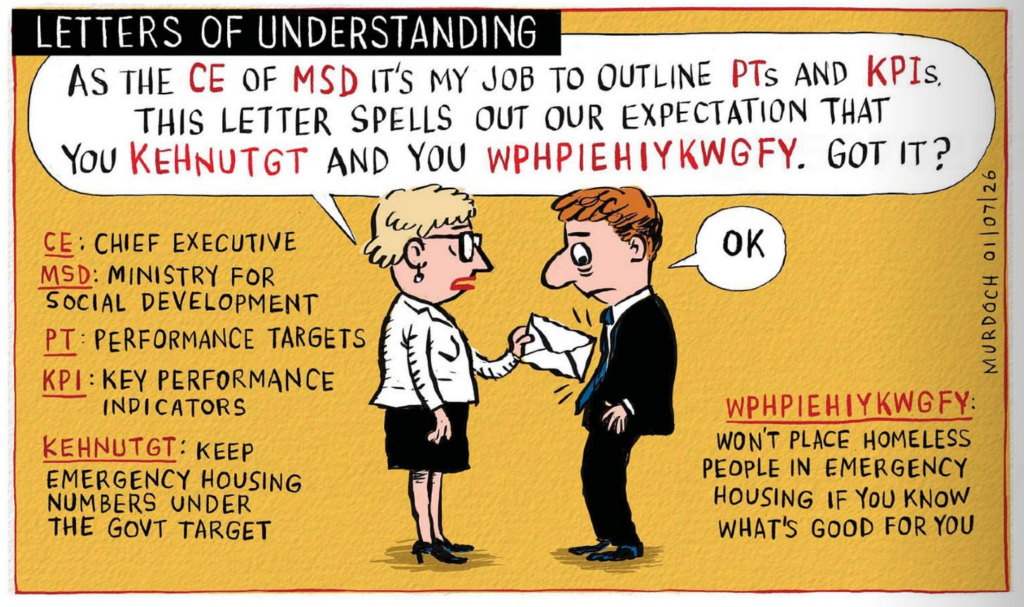
- Tightened the eligibility for people to get into decent housing solutions and required staff at MSD to work to make it as hard as possible for people who are genuinely needing accommodation this cartoon says it all:
- They have passed “move-on” orders against the advice of officials as reported by Emma Ricketts at Stuff who reported
rough sleeping and begging did not accidentally drift into the bill. They appear to have been left there by ministerial choice, against official advice. Police warned that they did “not support criminalising rough sleeping and non-aggressive begging”, describing such behaviour as a nuisance for retailers but still at “the low end of the spectrum” of anti-social behaviour. Police wanted the focus narrowed to genuinely risky conduct — aggressive begging, intoxicated aggression and fighting — and warned that move-on powers should not criminalise behaviour arising from mental health and social need.
She then went on also say:
a December aide-mémoire to Justice Minister Paul Goldsmith reportedly warned that Treasury, Crown Law, Corrections, Police, MSD, the housing ministry and Oranga Tamariki all had concerns, especially about orders capturing people experiencing homelessness. So when ministers say the bill does not criminalise homelessness, the honest response is: their own officials appear to have told them that it would.
So when ministers say the bill does not criminalise homelessness, the honest response is: their own officials appear to have told them that it would.
- It wasn’t just government departments which criticized the proposal every submission to the “Move-on” legislation spoke against it, including a former judge in this article https://www.rnz.co.nz/news/politics/764022/former-judge-says-proposed-move-on-orders-are-careless-and-callous who submitted:
“There is no place in the world where the use of police and criminal justice powers and facilities has ever succeeded in achieving the types of aims this bill has. Nowhere.”
Bernard Hickey wrote in great depth on homelessness on many occasions, here is one of his summaries:
Aotearoa’s decades-long housing crisis is now deep into another winter of discontent.
Last week’s events show the Government’s cuts to state house building and emergency housing in motels through 2024 have come home to roost even harder in 2026 than seen in the winter of discontent in 2016, when Te Puea Memorial Marae in Māngere opened its doors to Auckland’s homeless in the absence of Government action. It became an election issue the next year.
Add in this years ‘moving on’ orders going through Parliament that will criminalize rough sleepers as young as 14 years old, and effective cuts to rent subsidies for Kāinga Ora tenants and Accommodation Supplement recipients, and 2026 is shaping up as New Zealand’s housing crisis annus horribilis.
Bernard continued:
- Staff at MSD were threatened¹ in late 2024 with the sack unless they kicked people out of motels to meet the Government’s target of cutting the numbers of people housed in motels by 75% by 2030.
- MSD achieved the target five years early, but only by failing to find and offer other places to live for around 30% of the 4,000 people forced to leave the motels, with just 20% of those moving out of transitional housing going into permanent home²;
- Those missing 1,000 or so homeless people were not tracked, and homeless shelters and food banks are reporting hundreds more people are now living on the streets, especially in Auckland;
- The Auckland City Mission has called on the Government to fund at least 200 new homes for many hundreds more people sleeping on the streets in Auckland with nowhere to go after the Mission closes each night at 5pm;
- Prime Minister Christopher Luxon admitted³ after being asked for the seventh time in a news conference that he did not know homeless people in Auckland had nowhere to go after 5pm, but he said he was comfortable homeless people were being offered enough help; but,
- MSD admitted it rejected 30% of applications for emergency housing because applicants were deemed not eligible, with the criteria of ‘caused their own homelessness’ used as the main reason for rejection; and,
- HUD reported in its Homelessness Insights report for the March quarter that Health NZ had recorded 1,037 people using hospitals last year were homeless, vs 790 in 2023, and Corrections reported 532 ex-inmates were homeless last year, vs 430 a year earlier. Health NZ also recorded 1,631 mental health patients were homeless last year.
Leave a Reply