The influence Poverty has on a life
This issue came home with a jolt recently as I listened to my wife speak at the funeral of her mum, my mother-in-law. Jean’s story was an inspiring one. She was born into poverty in the same square in London as Charlie Chaplin had, a generation or so before. There was one toilet between 4 units. All the children slept in one bed. When their dad became unable to find work during the depression their mother cooked toffee apples and sold them on the side of the street. If ever the toffee became burnt the didn’t have food to eat. Eventually their father was so sick, and they were so poor, in desperation their mother took the 5 children to a Police Station and said she had found them. The Police charged Pam’s grandmother with abandoning her children and she was sent to prison with the recommendation that she be penalized by hard labour. Jean never saw her mother again and grieved that for the whole 96 years of her life.
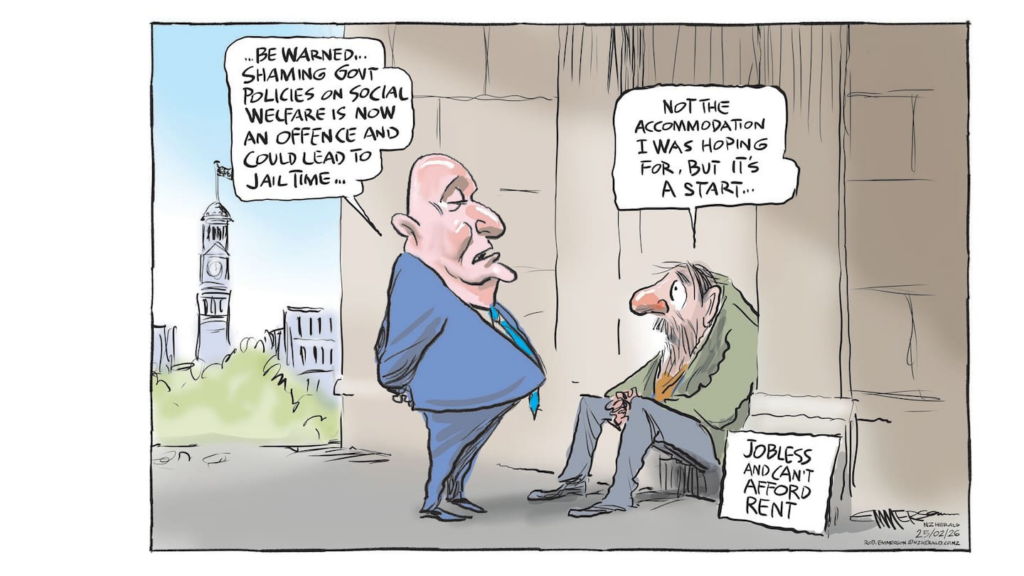
I tell this story because we have similar attitudes manifesting themselves in our government here in NZ. Pam is a generation away from abject poverty. The same attitude toward poverty being promoted by a government which judges those who are struggling through life.
Here’s how commentator, Bernard Hickey summarized the government’s attitude towards the homeless and those begging on our streets:
- The Lead – Justice Minister Paul Goldsmith and Police Minister Mark Mitchell announced yesterday the Government planned to change the law to allow Police to ‘move-on’ homeless people aged over 14 from city centers for 24 hours, with breaches punishable by a $2,000 fine, which most won’t be able to pay, or 90 days in prison, which would cost the taxpayer $49,680 per person at a cost of $552 per night for 90 nights¹.
- The Sidebar – The move to threaten to imprison the homeless came after the Government saved the annual equivalent of $156 million over the last 18 months by removing 3,525 people from emergency accommodation in motels at a cost of $233 per person per night.² Social service providers reported³ a doubling of homelessness to 940 in Auckland by September last year after the emptying of motels.
- The Reaction – Homeless people described the ‘move on’ orders as ‘draconian bullying,’ while social service providers said the homeless needed to be housed rather than imprisoned. PM Christopher Luxon told NewstalkZB this morning: “The bigger issue is like Chuck and Mary coming in for their once-in-a-lifetime trip to New Zealand on a cruise ship, walking around downtown and getting intimidated because someone’s sitting on the doorstop of a shop they’re trying to get into, threatening, shouting at them, abusing them. Right now it doesn’t trigger an offence under other pieces (of legislation), but by putting this in place that helps.”
- The Perspective – The Government has added 2,000 beds to the prison system⁴ since its election in November 2023, while its moves in Budget 2024 and Budget 2025 have delivered 420 new social homes⁵ and it has funded places for an extra 113 people in ‘Housing First’⁶.
- In my view – The Government is betting it will have to imprison a much lower number of people than it housed in motels, even though it costs more than twice as much per night to house a person in prison. The Government’s fiscal position would be net better off if it imprisoned fewer than 774 homeless people. If it only imprisoned 280 people over a year for 90 days each then the total annual cost of $13.9 million would still leave savings on motels of $142 million per year.
- In summary – The Government has chosen to threaten homeless people as young as 14 with prison in order to save $142 million per annum, and to reduce its borrowing requirements by $142 million, as requested by Treasury, which worries global bond investors might boycott New Zealand Government debt, even though last week’s bond tender of $450 million of bonds received bids of nearly $4 for each 1$ offered.
- The bottom line – The savings for New Zealand taxpayers as a whole due to the lower borrowing requirement would amount to less than a tenth of a basis point, equivalent to savings to the taxpayer of $208,500 per year, or less than 3.7 cents per person per year. A tenth of a basis point off the cost of a mortgage would save the average mortgage payer $3.38 per year or 6.5 cents per week.
In this article Move-on orders are a game-changer for fixing the nation’s complex problems | The Spinoff the writers suggested with tongue in cheek about comments made by Minister Paul Goldsmith who said:
“Of course, the law applies everywhere in the country so if you’re told to move on and you go up the road and start doing the same behaviours again, then you’ll be subject to another move-on order until the message gets through that society doesn’t tolerate these activities,” he said.
The author suggested the futility of these moves:
It’s a novel approach, and one ripe for adaption to other policy areas. For a long time, the Ministry of Primary Industries has been spending time and money trying to rid Auckland’s North Shore of the yellow-legged hornet. It’s invested heavily in public awareness campaigns and eradication efforts. But perhaps the problem is less the hornet itself, and more the fact they’re in Auckland, where Chuck or Mary could jump off a cruise ship on their once-in-a-lifetime trip only to be stung into organ failure by an aggressive insect. MPI could save time and money by catching then transferring the hornets to a less recognisable location such as Palmerston North.
In this article https://www.thepress.co.nz/nz-news/360955296/homeless-move-orders-would-mean-most-expensive-emergency-housing-nz the question was raised:
agencies working directly with homeless people to find them housing, mental health and addiction support, are asking where people with nowhere else to go were supposed to ‘move on’ to.
The Christchurch Methodist Mission’s Nicola Fleming, who managed both a homeless housing programme and an outreach programme, said the organisation had known the proposed law was coming, and had told the Government they “strongly opposed it”.
She described the proposal as “criminalising homelessness”, saying fines of up to $2000, not to mention the threat of jail time, was “ridiculous”.
“I think the problem is we have all these wait lists. So the expectations from the public, and possibly business owners, is that we’re going to house them quickly … [but] you can’t build houses in three months and put everyone in them,” she said.
The Christchurch City Missions CE said:
people who were homeless had complex needs and may have a mental health issue which would genuinely prevent them from understanding ‘move on’ orders. They were seriously unlikely to have the money to pay a fine. Sending homeless people to jail would be “the most expensive form of emergency housing” in the country, she said.
Thankyou Gary.
This needs to be said, and repeated, and repeated.
Surely 40 years of the neo-liberal greed-based cult is long enough to prove it a societal failure. Unfortunately many “middle-income” people have become wealthier at the expense of those further down the “ladder”. Only the wealthy (or those from wealthy families) can afford housing, whilst those at the bottom can’t afford a decent life or children. The demographic implosion will see the end of neo-liberalism, but at what social cost?
Good post Gary. Cheers, Mark Schroeder